

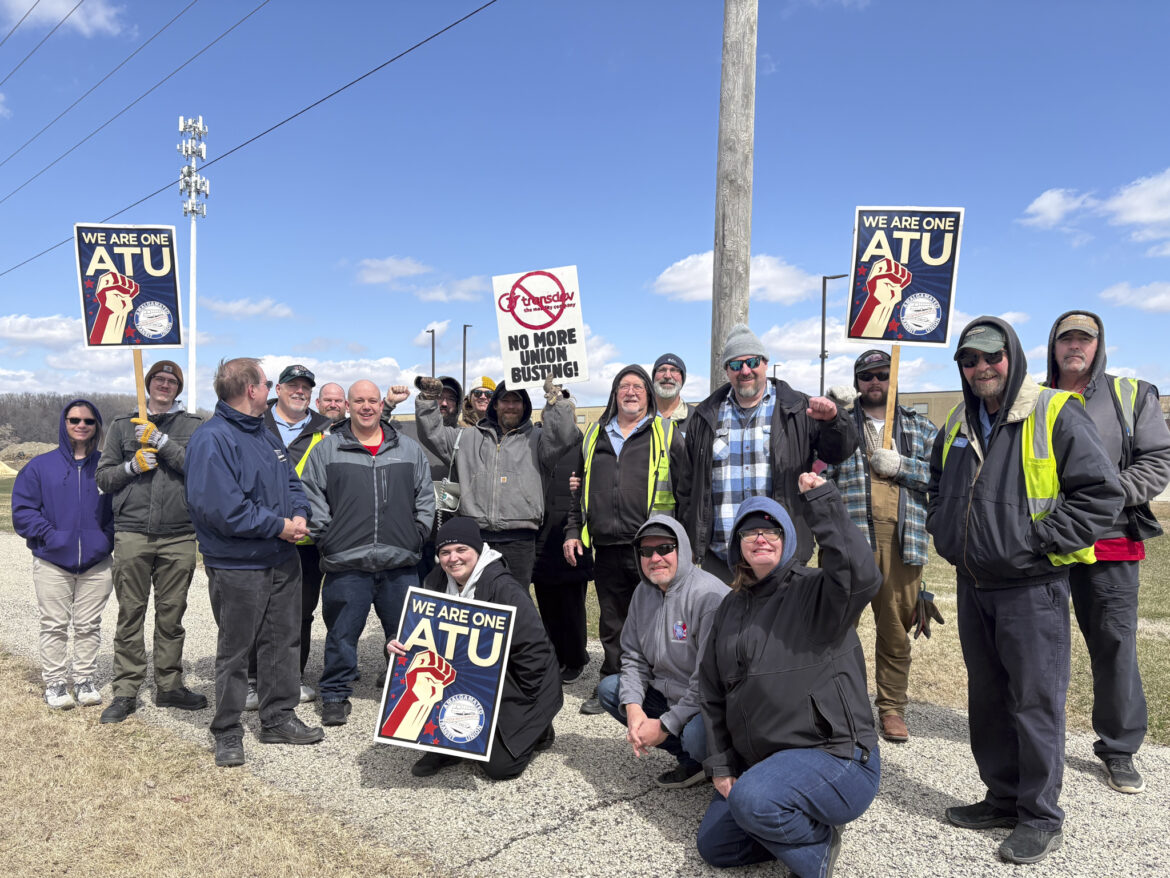
Rochester Public Transit workers after a march on the boss earlier this year, putting pressure on employer as a part of a contract campaign.

Documents obtained through a Freedom of Information Act (FOIA) request show that bus drivers for Rochester, Minn., are being monitored by “artificial intelligence” technology for alleged actions like distracted driving and running red lights, and at least one city official acknowledged the system feels “intrusive” to workers. Rochester Public Transit (RPT) is working with a private management company, Transdev, that is contracting with a private AI company, Lytx, to surveil transit workers on city buses.
The workers, represented by the Amalgamated Transit Union (ATU) Local 1005, say that the AI-surveillance system is invasive and incapable of perceiving the nuances of the decision-making required while operating city buses. The union alleges some workers have been unfairly disciplined and fired by managers using Lytx’s AI-powered camera and surveillance system without sufficient human oversight or transparency.
While Rochester Public Transit is a public agency, the management company Transdev, and the AI surveillance company, Lytx, are both private and therefore a contract cannot be requested through the FOIA. However, Workday Magazine was able to access communication these companies have with city officials, and that communication contained numerous mentions of Lytx-operated cameras being used to surveil workers as they drive.
In an email sent in March, the transit and parking director of the city of Rochester, said, “The cameras utilize ‘AI’ to determine things like: distracted driving (which could be holding an object in your hand, looking out the window for too long, eating, etc), or running of red lights or stop signs. Previous drive cam technology utilized sensors within the device that would only be triggered if someone accelerated aggressively, applied hard brakes, or performed hard cornering, etc. The increased use of the cameras to really monitor driving and provide a safe experience, is an incredibly useful tool. However, it does feel intrusive, and I understand that sentiment from the drivers.”
A 2024 Safety Plan Worksheet with Transdev branding lists various objectives and goals, including one area titled, “Effective Management of Drive Cam program.” Beside the objective, the worksheet lists action steps, including, “daily checks on drive cams that have come through Lytx” and “Identify unsafe behaviors and improve those identified behaviors through coaching” carried out by “safety manager” and “road supervisors.”
In an email exchange in February 2025, a Rochester Public Works manager stated, “We are in the process of equipping all service vehicles in the Rochester system with Lytx cameras to ensure full fleet coverage.”
It is still unclear how Transdev, Lytx, and the city of Rochester exchange information obtained from the AI-powered surveillance cameras, and neither company nor the city responded to queries about the specifics. In a May 2025 email exchange between two city of Rochester employees, one city employee asks, “The camera facing the windshield on that bus was not working but there is footage from the angle facing the front door and right side wind shield. Transdev has great footage from their Lytx system. It was showing the driver and the front of the bus. Is there a way to get the footage from them?”
In a statement from a representative of Transdev, the company said, “These tools are designed to assist in identifying potential safety-related events so that trained safety and operations professionals can review them in context. All evaluations, coaching, and employment-related decisions are made by qualified personnel in accordance with company policies, collective bargaining agreements where applicable, and local regulations.” The company specified that access to video and related data is “restricted to authorized individuals and is used for legitimate business purposes such as safety, training, and incident review.”
In response, Nathaniel Huertas, a union steward and dispatcher, reiterated that the union has struggled to gain access to footage and data collected by the AI-powered cameras. He states, “We would like to see changes like greater transparency regarding how the technology works, clear answers regarding how AI-generated alerts are used, we would like meaningful access to evidence and a process that allows employees and unit representatives to independently evaluate the same evidence management relies upon.”
Huertas continued, “We had some problems as well with video access, where management may review footage for days, weeks, or months, but employees and union representatives often see the footage for the first time during a display or meeting. So, management controls the footage, the computer, the timing, the meeting, and the process.”
In a statement from the city of Rochester, a representative said, “The city of Rochester does not own or operate the Lytx camera equipment; the contract is held by Transdev. Because Transdev is the system operator, the City cannot speak to or interpret the impressions or perspectives of their employees.”
Workday Magazine reached out to Lytx and did not receive a response by deadline.
Huertas says that many of the union’s questions regarding the AI camera software have gone unanswered by Transdev. Huertas asks, “If management is confident in the evidence, why is obtaining copies of relevant footage becoming more difficult than it was in the past? Why is the union denied the ability to independently review that same context? When a safety manager says the camera AI is triggered, how is that not evidence that AI is part of the disciplinary process rather than just a passive recording tool, as they claim?”
Some unions have sought protections from such monitoring. In a separate contract with the Twin Cities Metro Transit contract, workers represented by ATU Local 1005 have a stipulation that states that surveillance cameras cannot directly monitor the bus driver while they work. In an interview with Workday Magazine, David Stiggers, president of the ATU Local 1005, states that this contract language was important for drivers in order to “not make an already stressful job more stressful.”
Transit operators in Rochester Public Transit do not have the same stipulation in their contract, opening up drivers to be directly surveilled as they operate city buses. In their recently ratified contract with Transdev, the entity that employs them, workers agreed to a 6-month trial period where the company will follow a progressive disciplinary structure following AI-flagged violations rather than immediate suspensions based on AI cameras reports. Workers say that there has already been a reduction in overreaching disciplinary action and mistaken AI-flagged violations and would like to see the protection become a permanent policy.
The surveillance in Rochester is a part of a larger trend in public transit systems, as well as in school bus transportation, city vehicles, and commercial trucking to monitor drivers directly while they operate the vehicle with AI-powered surveillance technology. While camera systems to monitor drivers are not new to these industries, the AI software that flags potential infractions is what many workers consider to be overreaching and at times an inaccurate assessment of a driver’s performance.
Adriana Gomez has worked in Rochester’s public transportation for almost 18 years, first as a bus driver and now as a dispatcher. Gomez says that the company has been overly relying on the AI system’s alerts in management and disciplinary decisions that were previously made by trained human beings with Commercial Driver’s Licenses (CDLs), who better understood the complexities of driving buses filled with people.
“You have a bus full of people and you’re going through a yellow light or green into a yellow. You can’t slam the brakes because you can hurt your riders. Some of them can hold on, but we have a lot of seniors. So we were trained to go by that yellow light because it’s safer,” explains Gomez.
Workers say that the current AI surveillance system cannot understand such nuances of the job, and it flags these incidents as violations which then lead to disciplinary action against workers.
Workers share other situations where the AI system can misread drivers’ decision-making for example, swerving or breaking to avoid unexpected pedestrians or animals in the road. A worker also shared an incident where a street construction project had police officers directing traffic and overriding red lights. They allege that the AI flagged the driver’s wrongdoing without being able to understand the context. Workers also allege that the AI system flags distracted driving when workers look away to observe a potential hazard off-road.
Adam Buzbee, a long-time Rochester Public Transit employee and leader within the union has been outspoken regarding Transdev’s AI-powered cameras and management practices. Buzbee was fired by Transdev in 2024 and he is currently in negotiations to get his job back.
Huertas said, “The cameras are not new. The union is not about opposing cameras. We’re not about opposing technology or opposing safety in any regard. We had cameras on RPT buses for years before AI was integrated into the system.”
However, Huertas continues, “The issue is what happens when artificial intelligence begins analyzing employee behavior, generating alerts, flagging incidents, creating data, and influencing decisions that affect workers’ careers. Our concern is that the technology has become more sophisticated, while access to evidence has become more restricted.”
While the Rochester Public Transit workers voted to ratify a tentative agreement in May, Transdev’s contract with RPT is up for a vote at the Rochester City Council on July 6. The union states it will work with any company that wins the contract, but some workers plan to rally against Transdev at the July 6 hearing in favor of public management of the agency rather than private contractors.
“Our biggest dream is for the city to take over and run it instead of these for-profit companies,” says Buzbee.
Huertas emphasized the need for transparency from the transit agency’s private contractors, both for the workers and the public’s sake. “You can see [bus operators] through a glass window, we’re an open book.” He continues, “Workers deserve transparency, workers deserve accountability, workers deserve meaningful access to evidence, and workers deserve due process. Safety and fairness should go hand in hand.”
The psychological weight of being constantly recorded while operating a bus is compounded by the stress of that footage being processed with an untransparent AI software, Buzbee underscored. “We’re not machines, man.”