

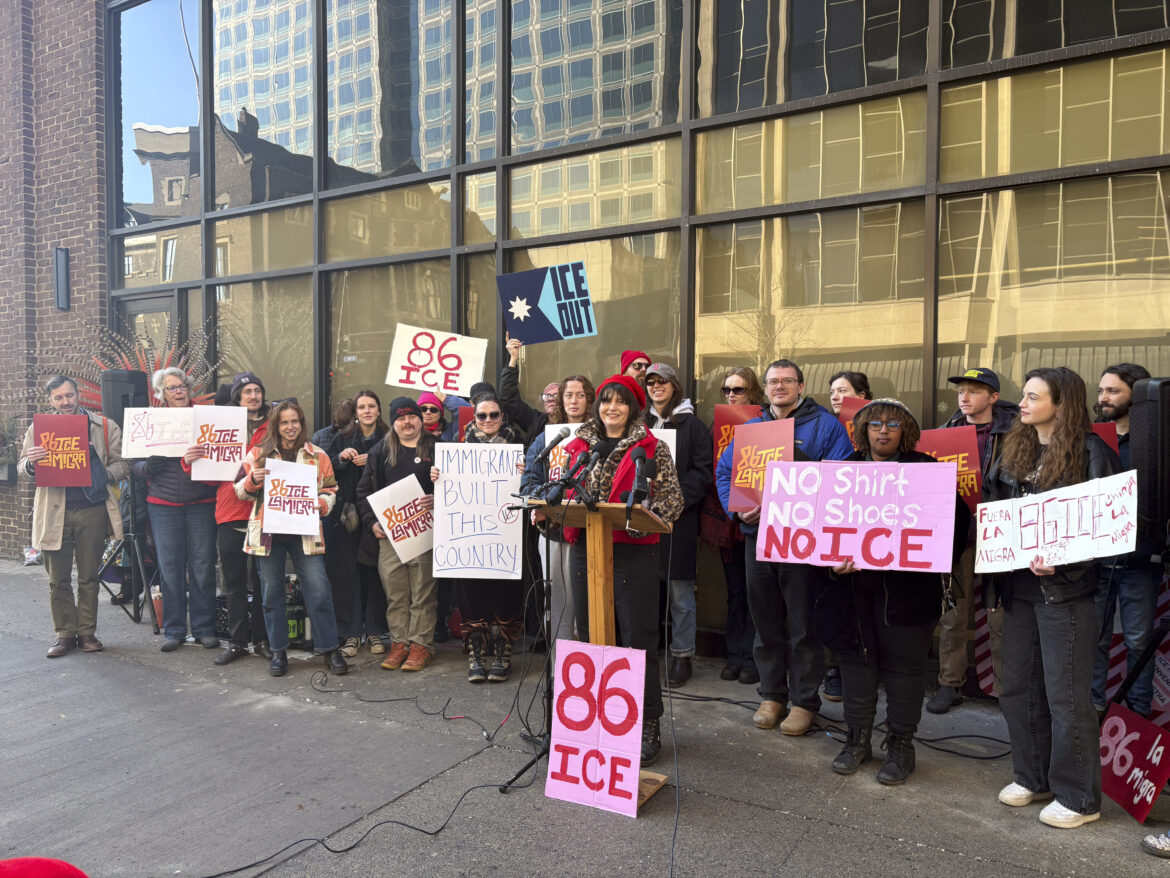
Restaurant workers rally outside the Minnesota Hospitality building in downtown Minneapolis.

On February 13, restaurant workers rallied outside the Hospitality Minnesota building in downtown Minneapolis to deliver a Valentine’s Day card asking industry leaders to ban ICE from restaurants. The workers also want stronger protocols for protections at restaurants, and know-your-rights trainings for restaurant workers on the front lines.
It’s not radical to refuse service to agents who are threatening and at times killing our community members,” said Jake, a line cook at prominent Minneapolis restaurants.
The rally was organized by the “86 ICE” coalition, supported by Restaurant Opportunities Center of Minnesota (ROC MN and Centro de Trabajadores Unidos en la Lucha (CTUL), which includes both front- and back-of-house restaurant workers and restaurant owners. The number “86” refers to restaurant and bar patrons who are kicked out of an establishment. Along with the “86 ICE” coalition demands, workers also voiced a need for financial stimulus for impacted workers—not just for small business owners, as proposed by Minnesota Gov. Walz.
Workers and allies held pink and red Valentine’s Day themed signs, reading, “No shirt, no shoes, no ICE,” “Don’t break our [heart], 86 ICE,” and “ICE is not invited to dinner.” After the press conference and rally, the coalition delivered their demands to Hospitality Minnesota, a trade association for the Minnesota hospitality industry, led by local restaurant, hotel, and resort owners.
Caiti Smith, a server for over 16 years in Minneapolis and an organizer with ROC-MN, said, “The economic harms will take years to recover from. This workforce keeps living on the frontlines and this is not sustainable.” She is concerned, she says, about the compounding crises of the ICE surge, the pandemic, and the murder of George Floyd in Minneapolis in 2020. According to a report from Minneapolis/St. Paul Business Journal, restaurants in Minnesota have seen a 50-80% decline in revenue since the beginning of the immigration crackdown in late 2025. In Minneapolis, small businesses are reporting revenue losses for small businesses as high as $81 million in January 2026.
An “86 ICE” coalition press release says demands include developing and implementing a preparedness plan empowering both workers and managers to take necessary steps to protect workers; denying entry to federal agents to the private areas of the business without a signed, valid judicial warrant; refusing service to known ICE and federal agents; granting employees the right to take time off work without punishment or fear of losing their job; and requesting a meeting with the company representative to discuss a path forward.
Patti, a restaurant and hotel worker in downtown Minneapolis for two years said that due to fears of ICE detention, she had not left her home until the February 13 rally. She shares that a friend of hers who works as a dishwasher was detained by ICE at five in the morning while waiting at a bus stop on his way to work. “A system for getting to work isn’t enough. We need proactive plans and know-your-rights training in restaurants,” she said through an interpreter.
Jake, the line cook, says restaurant workers have been organizing long before this moment, “but Hospitality Minnesota and other business associations blocked those efforts.” This included worker advocacy for the Minneapolis Labor Standards Board effort, which would have been aimed at raising industry standards for working conditions. In December 2024, Minneapolis Mayor Frey vetoed the board, with the support from restaurant owners and trade associations.
The owner of Lito’s Burritos in Minneapolis, Miguel Hernandez, was present and in support of the coalition’s demands. “I can’t have a business if my staff doesn’t show up. Without restaurant staff, owners have nothing,” said Hernandez. He acknowledged that although the ICE activity in Minnesota is set to decrease in the coming weeks, “ICE was here before the operation and it will continue after,” and encouraged other local restaurant owners to sign onto the coalition’s demands.
Workday Magazine reached out to Hospitality Minnesota and did not receive a response by deadline.
Remy, a bartender who has worked in the service industry for 10 years, described the painful experience many restaurant workers are facing of coming into work and seeing a coworker missing and wondering whether they were abducted by ICE or too afraid to come into work that day. “This trauma will continue to affect us long after the surge is over,” he said.
“We can’t keep living in the frontlines of devastating historical events without being listened to and treated with respect,” added Remy. The bartender ended his speech with a message dedicated to his immigrant coworkers who have been missing from work, saying, “Carlos, I miss you. Patricio, I miss you.”